

Low-Code influence on global tech industry
By 2025, Gartner predicts that 70% of new applications will be developed using low-code or no-code technologies, with the rise of citizen developers helping to fulfill the demand for new applications and address the shortage of skilled developers. According to the Low-Code Development Platform Global Market Report by The Business Research Company, low-code platforms aren’t just a buzzword, they represent one of the fastest-growing segments in enterprise software.
- The global low-code development platform market reached an estimated $50 billion in 2025.
- It is forecast to grow to more than $205 billion by 2030, representing a robust compound annual growth rate (CAGR) of about 32.7% over the period.
- This rapid expansion is driven by accelerating digital transformation priorities, growing adoption across industries, and the increasing need for faster application delivery.
This guide is intended for business leaders, IT professionals, and anyone interested in understanding the impact of low-code and no-code platforms on software development. As organizations face increasing pressure to deliver digital solutions faster and with fewer resources, understanding low-code and no-code platforms has become essential for staying competitive.
What Is the Real Difference Between Low-Code and No-Code in Practice?
In theory, the distinction is simple:
- No-code platforms are designed for non-technical business users as the target users. They do not require any coding skills or coding experience, relying heavily on visual interfaces, drag-and-drop components, and prebuilt logic. No-code development allows non-technical business users to develop applications without having to write even a single line of code.
- Low-code platforms are designed for users with some coding skills or coding experience. While they still use visual development and users may not need to write code line by line for every feature, some manual coding may be required for complex logic, integrations, and performance tuning. Low-code platforms are aimed at users who possess programming skills, enabling them to handle more complex logic and integrations.
Low-code platforms are more sophisticated than no-code platforms and can be used to build any type of application at varying levels of complexity.
In practice, the line often blurs. Many “no-code” tools eventually require scripting for advanced use cases, while low-code platforms market themselves as accessible to non-developers. The real difference tends to emerge during complex projects: low-code typically offers deeper extensibility and architectural control. Low-code platforms allow developers to add custom code, such as JavaScript or HTML, for advanced features and deeper customization.
What Are the Biggest Myths About Low-Code/No-Code?
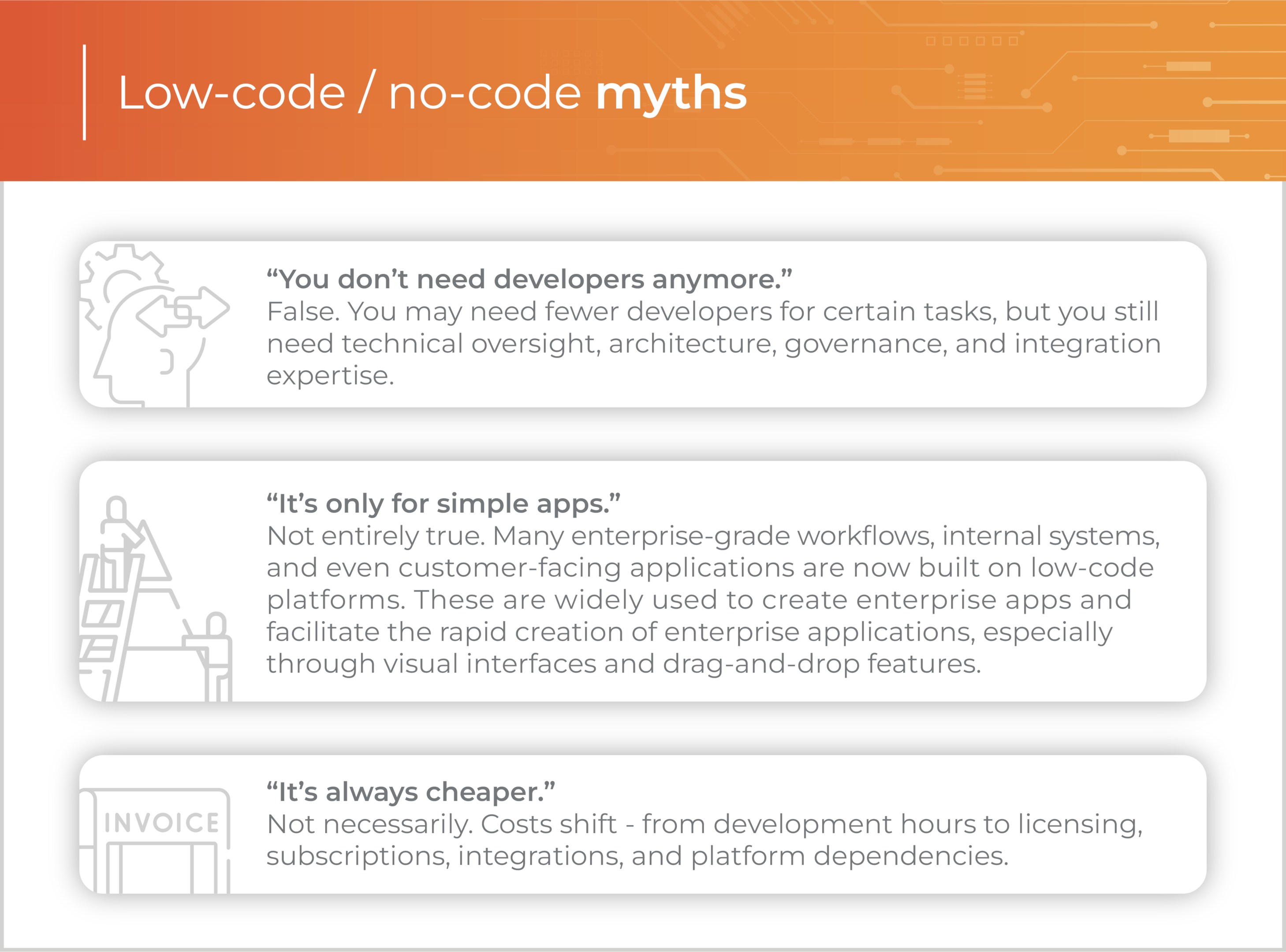
Several persistent myths shape the conversation:
 Democratization of IT for Business Users - or Vendor Dependency?
Low-code/no-code does lower the barrier to entry. Business teams can prototype and sometimes deploy solutions without waiting months for IT backlogs to clear. In that sense, it does democratize access to software creation. Non-technical users empowered by low-code platforms are increasingly able to build value-driven business applications. Low-code and no-code development both aim to democratize software creation and empower business users to quickly develop solutions tailored to their specific needs. The rise of citizen developers helps fulfill the demand for new applications and reduces the workloads of IT teams.
However, this empowerment often comes with trade-offs. Organizations become deeply embedded in a platform ecosystem. Migrating away can be complex and expensive. The more logic and data you build into a proprietary environment, the stronger the vendor dependency.
"While some fear that these tools might render traditional developers obsolete, the reality is more nuanced. These platforms allow professional developers to focus on more complex, high-value tasks, while non-technical employees handle simpler development tasks. These tasks can include automating and managing business networks, such as maintaining, troubleshooting, and upgrading organizational networks and systems, including both traditional and cloud-based servers. This shift promotes collaboration between technical and non-technical teams, enhancing overall productivity."
 Where Does Low-Code/No-Code Work Best and Where Doesn’t It?
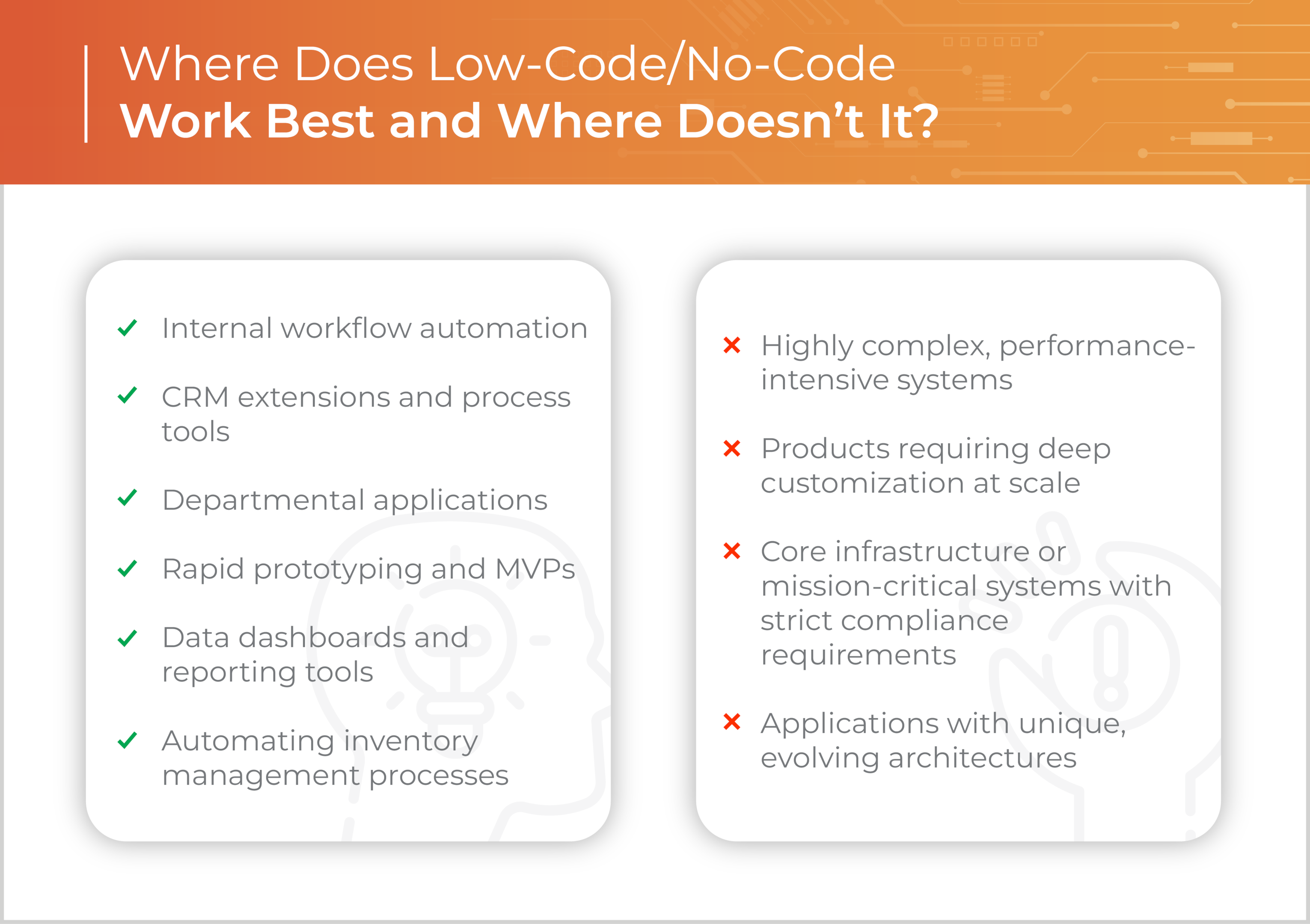 Some other good fits can be also:
- Automating hiring processes in HR departments
- Modeling manufacturing processes and enhancing smart factory operations
- Developing accounting workflows, including tax filing and loan approvals
- Creating customer service applications to enhance user experience
- Code app development and development projects using low-code platforms enable rapid automation and integration across business functions, supporting initiatives in supply chain, manufacturing, finance, HR, and IT.
The sweet spot is process-driven, repeatable, business-centric applications - not highly specialized software engineering challenges.
Application Development Tools: The Low-Code/No-Code Landscape
Low-code development platforms offer a visual integrated development environment, combining intuitive drag-and-drop interfaces with the ability to add custom logic when needed. These platforms also include built-in connectors and APIs for seamless integration with major enterprise systems like SAP, Salesforce, and Oracle. They also provide a collaborative integrated development environment (IDE) that accommodates users with varying technical skills. This approach allows non-technical business users to quickly design, build, and deploy applications, dramatically accelerating the development process. By reducing the reliance on manual coding, organizations can respond faster to changing business needs and drive digital transformation across departments.
“Low-code is no longer just a tool for accelerating simple projects - it’s becoming a strategic layer in enterprise architecture. What we’re seeing now is a shift from experimentation to structured adoption. Organizations are putting governance models, integration standards, and long-term roadmaps around low-code platforms. The future will be shaped by the combination of low-code and AI. Development cycles will shrink even further, but the role of engineers won’t disappear - it will evolve. The real competitive advantage won’t come from building faster, but from building smarter and integrating low-code responsibly into the broader IT ecosystem.”
 Does It Really Reduce Costs or Just Move Them?
Low-code can reduce time-to-market, which often translates into business value. It can also lower initial development costs, particularly for internal systems. By reducing reliance on traditional development teams, low-code platforms enable existing staff to handle application creation and modifications, minimizing the need for dedicated software developers.
But costs rarely disappear. They shift:
- Licensing and subscription fees
- Integration complexity
- Platform scaling costs
- Long-term maintenance and customization
Total cost of ownership must be evaluated over years, not just at launch.
Is Low-Code a Temporary Shortcut or a Strategic Approach?
For some organizations, low-code is a tactical solution: a way to build something quickly while planning a more scalable system. For others, it becomes a core part of their IT strategy, especially in enterprises embracing hybrid architectures, where traditional development coexists with platform-based solutions.
The difference lies in governance. Without clear standards, low-code can create fragmentation. With strategy, it becomes a powerful layer in the digital ecosystem.
Is It a Threat to Developers or a Role Transformation?
Low-code is less a threat and more a shift. Developers increasingly move toward:
- Architecture design
- API creation
- Platform governance
- Complex integration
- Security and compliance oversight
Professional developers use low-code platforms to automate routine tasks, which frees up their time to focus on more complex customizations and extensions. Routine CRUD applications and workflow systems may require less hand-coding. But complex system design remains deeply technical. Rather than replacing developers, low-code changes what they spend time on.
What About Maintenance After 3–5 Years?
This is where reality hits. Over time:
- Platform updates may affect existing apps
- Licensing models may change
- Custom logic can become harder to manage
- Knowledge gaps may emerge if “citizen developers” leave
Maintenance depends heavily on documentation, governance, and technical oversight. Poorly managed low-code environments can accumulate a different kind of technical debt - platform debt.
Security and Scalability: Are They Good Enough?
Security and scalability vary significantly by platform. Enterprise-grade low-code tools often offer:
- Built-in identity management
- Compliance certifications
- Role-based access control
- Centralized control for data privacy, authorization, and compliance
Low-code platforms provide built-in controls and governance practices to help maintain security standards as applications scale. Organizations must implement strict data governance policies to mitigate risks associated with low-code development.
However, architectural limitations may emerge under heavy load or highly customized use cases. Security in low-code is often strong at the infrastructure level but weaker at the design and governance level if business users build apps without clear standards. Robust security measures are essential for low-code applications, including access controls and data encryption. Low-code platforms should support the types of security required by organizations, and app builders must use these features properly to avoid data leaks. Low-code development requires app builders to consult with IT and legal departments to ensure compliance with security and governance protocols.
How Is AI Changing the Low-Code Market?
AI is accelerating everything. Modern platforms increasingly include:
- AI-generated workflows
- Natural language app builders
- Automated testing
- Intelligent data mapping
AI lowers the barrier even further, allowing users to describe an application in natural language and receive a functional prototype. The combination of AI and low-code reduces not just coding effort, but design friction.
What Will the Market Look Like in Five Years?
In five years, we can expect:
- Greater consolidation among vendors
- Stronger AI integration
- More enterprise governance tools
- Clearer separation between “citizen development” and enterprise-grade low-code
- Hybrid architectures as the norm
The best low code platforms are cloud-native, providing scalable development and seamless integration with cloud services. Cloud support is essential for modern low-code platforms, enabling scalable development of cloud-native applications and access to a wide range of cloud services via drag-and-drop visual tools. Low-code will likely become a standard layer in enterprise IT, not a disruptive novelty.
Will Traditional Programming Be Replaced in Some Projects?
In certain domains, yes. Routine, process-driven, and internal applications are increasingly shifting to platforms. When considering low code vs no code vs traditional coding, it’s important to note that low-code bridges the gap between the simplicity of no-code and the complexity of full programming languages. In the broader code vs approach, low-code and no-code platforms democratize application development, while traditional coding remains necessary for more complex solutions. Hand-coded solutions will become less common in these areas. Code app development enables organizations to rapidly create code apps for business functions such as supply chain, manufacturing, finance, HR, and IT with minimal traditional coding, accelerating digital transformation and process automation. But traditional programming will remain essential for:
- Complex systems
- High-performance products
- Infrastructure and platform development
- Advanced AI systems
Traditional coding involves writing each code line manually in programming languages such as C#, Java, and Python, requiring extensive programming knowledge and longer development timelines. In contrast, low-code development is a method of creating software applications with less coding than traditional code-first development, making it more accessible and efficient for many business needs. Rather than replacing classic programming, low-code is reshaping where and how code is written.
"What stands out most is the growing market demand for low-code expertise. Companies are no longer experimenting - they are institutionalizing these platforms as part of their core IT architecture. This requires not only technical capabilities but also strong business alignment and architectural oversight. We are actively delivering such initiatives, supported by cross-functional teams of analysts, developers, and platform specialists who ensure that low-code solutions are implemented in a scalable, secure, and strategically aligned way.”
 Conclusion: Evolution, Not Revolution
Low-code and no-code are not magic solutions, nor are they empty hype. They represent a structural shift in how organizations think about building software. The key question is no longer whether to use low-code, but where and how strategically to use it. Used thoughtfully, it can accelerate innovation. Used carelessly, it can create new forms of dependency and debt. The difference lies not in the platform, but in the strategy behind it.
Finding highly skilled professionals can be challenging. At NATEK, our expert recruiters leverage years of experience in the IT market to identify and attract top tech talent in low-code and other technologies. Go to our contact page or message our Sales Prospection Team Lead Andrzej Osman on LinkedIn or at [email protected] to tell us about your needs. Contact us and #growITwithus!