

Can the future of humans in a job market, in a world of rapidly expanding influence of AI, still be bright? While many tasks requiring precision and repeatability can easily be solved by automation, many aspects of project development, and therefore business development, still rest in the hands of the actual people with their unique, human approach and unmatched creativity.
As technological development advances, market needs and customers' expectations change. But one thing remains constant – people are paramount. So what areas and skills will be crucial for them to possess to continue their luck on the job market and remain a vital part of every IT project? Let's learn more about the several key trends and opportunities for non-technical professionals in the IT industry!
Increased Demand for Hybrid Skills
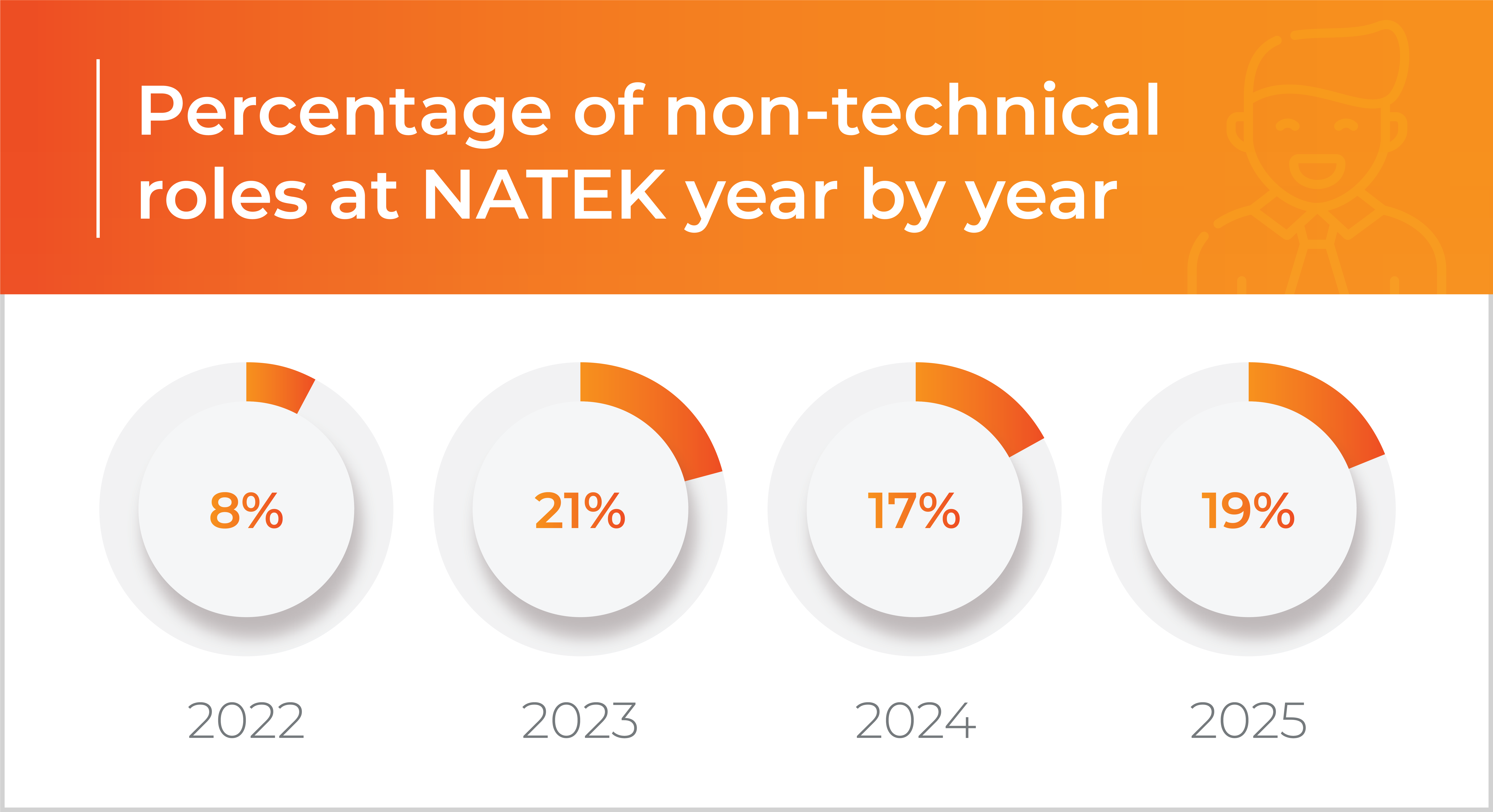
Non-technical roles that combine business acumen with a basic understanding of technology are becoming more valuable. Positions like business analysts, project managers, and product managers are crucial for bridging the gap between technical teams and business objectives. These roles often rely on data to support business decisions, ensuring that strategic and operational choices are informed by accurate insights. Data scientists analyze and organize data to determine trends that can influence business decisions, further supporting the organization’s direction. It’s visible both in the global market and in NATEK organizational structure. Take a look at the percentage distribution of non-technical job titles in our Team.
Focus on Soft Skills
Skills such as communication skills, critical thinking, and problem-solving are increasingly important. These skills help non-technical professionals effectively collaborate with technical teams and contribute to strategic decision-making, with communication listed as one of the most requested skills across millions of recent job postings in non-technical roles.
AI and Automation
Although non-technical professionals don’t need to be experts in coding or AI algorithms, understanding the basics of AI technologies will be obviously very important. These technical skills include:
- Data Literacy - Understanding how data works, how to interpret it, and how to leverage it in decision-making is crucial. AI relies heavily on data, and being able to work with data is a key skill for non-techies.
- AI Tools - Familiarity with AI-powered tools like ChatGPT, Canva, and Grammarly can greatly enhance productivity and help non-technical professionals automate tasks.
- Automation and Workflows - Understanding how to automate workflows using AI tools like Zapier or Microsoft Power Automate will help non-technical professionals save time and reduce manual errors.
“While AI and automation are transforming many aspects of IT, they also create opportunities for non-technical roles. Automation is increasing the demand for professionals who can manage teams, processes, and decisions in non-technical roles. Understanding how to leverage AI tools and technologies can enhance productivity and efficiency without requiring deep technical expertise. Non-technical roles also decide how speed from automation is used in business processes.”

Diverse Career Paths
There are numerous non-technical roles in IT, including marketing, sales, human resources specialist, and customer support. These roles are essential for the overall success of tech companies and offer various career advancement opportunities.
Many companies offer comprehensive training and development programs even for entry-level candidates, enabling new hires to quickly build the skills required for success and progress along a fast track to more senior roles. With competitive salaries, robust benefits, and ample opportunities for growth, the IT career field is an attractive option for professionals from a variety of backgrounds.
As a leading IT outsourcing company located across CEE region, we are a crucial part of transforming and improving the job market for technical and non-technical experts. Currently we have well over 120 positions open, waiting for the right Candidate. Could it be you? Head on to our Job page, and apply to #workITwithus!
Education and Training for Non-Technical Roles
“Staying up to date with the latest trends and technologies is crucial for the proficiency of the company. That’s why at NATEK both technical and non-technical professionals can benefit from online courses, certificate programs, and workshops to enhance their skills and keep growing as experts. This way we are creating a supportive and ambitious work environment, which directly translates to high performance results and positive feedback from our Customers.”

Pursuing a non-technical role in the IT industry can begin with a variety of educational and training pathways, relying not just on prior experience but instead on applied skills, certifications, or short-term training programs that focus on practical business use rather than just technical depth.
A bachelor’s degree in business administration, communication, marketing, or a related field provides a strong foundation for many non-technical positions. For those looking to specialize or upskill (and according to the World Economic Forum, the number is impressive, with an increasing share of the workforce (50%) having completed training as part of long-term learning strategies in 2025), certificate programs in data analytics, web development, or technical writing can open new doors and enhance career prospects. Many institutions now offer self-paced learning options, allowing professionals to develop their skills at their own pace and stay current with the latest industry trends. As the IT industry continues to evolve, ongoing education and training are essential for professionals to remain competitive, adapt to new technologies, and advance in their careers.
Empowering Non-Technical IT Employees with Low-Code/No-Code Platforms
According to the World Economic Forum, the key soft skills (or as some like to call them these days "Power skills") required in the IT industry include analytical thinking, leadership, system thinking, problem-solving, talent management, flexibility, agility, emotional intelligence, and time management. Low-code/no-code platforms complement these skills by enabling employees to quickly prototype and iterate on solutions, fostering a culture of continuous improvement and innovation.

In today’s rapidly evolving IT landscape, low-code and no-code platforms are revolutionizing the way software is developed, making it accessible to a broader range of individuals. These platforms enable non-technical IT employees to take on basic technical or developer roles, including interacting with IT systems, thereby enhancing their career prospects in the IT industry.
What Are Low-Code/No-Code Platforms?
Low-code platforms provide a visual development environment where users can drag and drop components to build applications, requiring minimal coding knowledge. No-code platforms take this a step further, allowing users to create applications without writing any code at all. These tools enable users to create applications without needing traditional computer programming skills. Examples of popular platforms include OutSystems, Mendix, and Microsoft Power Apps for low-code, and Bubble, Zapier, and Webflow for no-code.
Impact on the IT Job Market
The rise of low-code/no-code platforms is reshaping the traditional software development job market.
While some fear that these tools might render traditional developers obsolete, the reality is more nuanced. These platforms allow professional developers to focus on more complex, high-value tasks, while non-technical employees handle simpler development tasks. These tasks can include automating and managing business networks, such as maintaining, troubleshooting, and upgrading organizational networks and systems, including both traditional and cloud-based servers. This shift promotes collaboration between technical and non-technical teams, enhancing overall productivity.

Career Growth Opportunities with NATEK Team
By leveraging these platforms, non-technical IT employees can transition into more technical roles. They can develop applications, automate workflows, and solve business problems without needing extensive programming skills. This democratization of software development empowers employees to contribute more significantly to their organizations and opens up new career paths. These opportunities can improve employment prospects for non-technical employees by enabling them to gain relevant skills and experience valued in the IT sector.
If you're ready to take your career to another level, take a look at our job opportunities, apply for the preferred roles, and join NATEK Team!
This article was created with the immense support of our Experts – Jarosław Dudek and Mateusz Doziwski, Process Managers at NATEK.