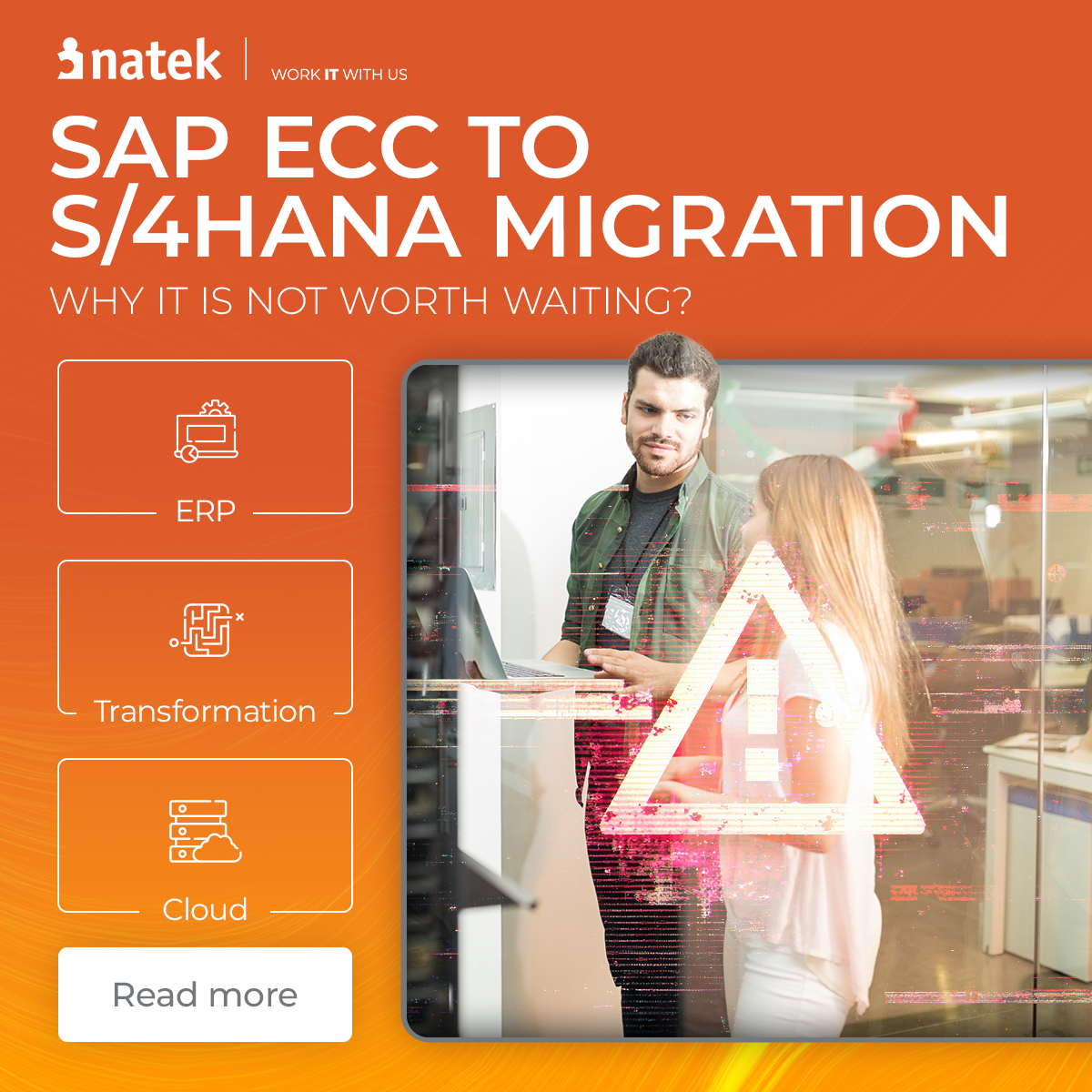


A few years ago, migrating from SAP ECC to SAP S/4HANA was just one of many initiatives sitting on IT roadmaps. Today, the situation looks very different. With the end of mainstream support for SAP ECC approaching, organizations that have postponed the decision are increasingly facing the reality that action can no longer be delayed.
More importantly, this is not merely a technology project. For most enterprises, ERP serves as the operational backbone that supports finance, procurement, logistics, manufacturing, and HR processes. Any change to that foundation has a direct impact on the entire organization.
Why Are So Many Companies Still Waiting?
Paradoxically, the main issue is not a lack of awareness. Most organizations understand that migration from SAP ECC is inevitable. The challenge lies in the scale and complexity of the undertaking.
In many enterprises, SAP systems have been continuously developed and customized for 15, 20, or even more years. During that time, hundreds of custom programs, integrations, reports, and enhancements have been created to support unique business requirements. What was once a standard ERP implementation has evolved into a highly customized business platform. As the main component of SAP Business Suite, SAP ECC is central system used across whole organization.
"Many organizations see S/4HANA migration as a technology project. In reality, it is a business decision that determines how the company will operate for the next decade."

Three Paths to SAP S/4HANA
Organizations planning their transition to S/4HANA generally have three strategic options. SAP introduced this model to give customers more flexibility in how they modernize. The usual paths are a greenfield, a brownfield and selective data transition approach.
In many enterprises, SAP systems have been continuously developed over many years, often evolving far beyond a standard implementation of ERP solutions. SAP ECC uses integrated modules to bring finance, logistics, human resources, and supply chain functions into a single platform. Over time, organizations add custom programs, integrations, reports, and enhancements, and many depend on ECC for financial accounting, material management, inventory management, and other automated key business processes. It also consolidates financial and transactional information across core business areas into a single source of truth.
The more customization, the more complex the migration becomes. Many of these environments also support real-time data processing, financial reporting, and dashboard-based visibility into performance, which increases the risk of disruption during the move.
That is why choosing the right migration path matters. Some organizations opt for a new implementation, while others prefer system conversion to preserve more of the existing setup. In either case, careful data migration planning is essential to reduce business risk and maintain continuity.
Brownfield: The Fastest Route
A Brownfield approach involves converting an existing SAP ECC environment directly into SAP S/4HANA. Historical data, configurations, and most custom developments remain in place.
While this is often the quickest way to achieve compliance with SAP's future roadmap, it comes with a significant trade-off. Organizations planning their transition to S/4HANA generally have three strategic options, and since SAP S/4HANA was launched in 2015 as a next-generation ERP, SAP has framed these pathways from ECC-era landscapes as system conversion, data migration, and selective data transition. Unlike ECC, which could run on different databases, sap hana serves as the underlying database for S/4HANA, with the hana database handling the in-memory data platform layer.
Companies frequently end up carrying years, or even decades, of technical debt into the new platform. As a result, many Brownfield projects deliver a modern ERP system without fundamentally improving the underlying business processes or architecture.
"Brownfield is often the safest-looking option. The problem is that many organizations end up migrating twenty years of technical debt into a brand-new platform and wonder later why the expected business value never materialized."
Greenfield: Starting from Scratch
The second option is a Greenfield implementation, where the organization builds a new S/4HANA environment from the ground up around standardized business processes. Processes are redesigned, best practices are adopted, and the legacy system becomes an archive for historical data rather than the foundation for future operations.
Although Greenfield projects require a greater organizational commitment and stronger change management, they often provide the opportunity to simplify operations, eliminate unnecessary complexity, and fully leverage S/4HANA capabilities. For systems that have evolved over two decades, starting over can sometimes be more practical than attempting to migrate every customization ever created.
A Selective Data Transition
Selective migration, combines elements of both approaches. Organizations create a new environment while using a selective data transition approach, with targeted data migration of chosen information, business processes, and configurations from their existing landscape. This model offers greater flexibility and can help balance innovation with continuity, though it typically requires more advanced planning and execution.
Cloud Changes the Rules of the Game
For many organizations, migrating to S/4HANA also means making a decision about deployment strategy, including whether systems are deployed on premises or moved to newer models. SAP has made its direction clear by strongly promoting cloud-based offerings, including Public Cloud, Private Cloud, and SAP S/4HANA Cloud solutions.
This shift represents a fundamental change in how organizations think about ERP ownership. Traditionally, companies purchased perpetual licenses and managed their own infrastructure. In a cloud model, they move toward subscription-based consumption while transferring a portion of operational responsibility to SAP and its cloud ecosystem, with the cloud edition typically following a faster update cadence.
The benefits are clear:
- Reduced infrastructure management effort
- Faster access to innovations and updates
- Improved scalability
- Greater operational flexibility
This model also strengthens integration across broader SAP solutions, including SAP Ariba for procurement and SAP Fieldglass for external workforce management. At the same time, organizations face new challenges related to subscription costs, licensing models, governance, and vendor management. Companies should therefore evaluate not only the initial migration costs but also the long-term financial implications of cloud adoption.
The Hidden Economics of SAP Cloud ERP
One aspect that remains surprisingly under-discussed is the economic impact of moving from perpetual licensing to subscription-based services, especially as SAP S/4HANA supports multiple deployment options, including on-premises, cloud, and hybrid models.
The transition often appears attractive in the short term. Organizations gain access to modern infrastructure and services without large upfront investments, whether they consider Public Cloud, Private Cloud, SAP S/4HANA Cloud, or another cloud edition aligned with SAP’s cloud ERP direction.
However, over time, questions emerge around additional services, licensing structures, user authorization models, support boundaries, and maintenance costs. Many companies only discover the full cost implications after they have already committed to a cloud strategy.
This is why cloud migration should not be treated solely as a technical initiative. It requires careful commercial planning, a clear understanding of the long-term operating model, and, within SAP’s cloud ecosystem, consideration of connected solutions when shaping deployment strategy.
Clean Core: The Foundation for a Sustainable and Future-Ready SAP Landscape
One of the key principles shaping modern SAP landscapes is the Clean Core strategy. Its objective is to keep the ERP system as close as possible to SAP standard functionality while building extensions through approved technologies such as SAP Business Technology Platform (SAP BTP). The business value of this approach goes far beyond technical considerations. Organizations with heavily customized ERP systems often face costly upgrades, increasing technical debt, and complex maintenance. By minimizing custom code, companies create a more stable, scalable, and cost-efficient ERP landscape that is easier to maintain and evolve.
A Clean Core strategy also enables faster adoption of SAP innovations. Systems aligned with SAP standards can implement new features, security updates, and regulatory changes with significantly less effort, allowing organizations to continuously improve their business processes instead of maintaining custom developments. In addition, Clean Core supports a more flexible cloud architecture. New applications and integrations can be built on SAP BTP rather than inside the ERP core, enabling innovation while preserving system stability and simplifying future upgrades.
Most importantly, Clean Core creates a solid foundation for future digital initiatives. Standardized processes and well-governed data make it easier to introduce automation, advanced analytics, and AI without adding unnecessary complexity, ensuring that new technologies deliver long-term business value rather than increasing technical debt.
What Does the End of SAP ECC Support Actually Mean?
One common misconception is that SAP ECC systems will stop working once support ends. The systems will continue to operate, but organizations will gradually lose access to security patches, legal and regulatory updates, software corrections, standard vendor support, and scheduled maintenance through service pack stacks.
Over time, this creates increasing operational and cybersecurity risks. It also makes infrastructure upgrades more difficult, as databases, operating systems, and related technologies evolve beyond officially supported configurations. This becomes especially relevant in the era of AI and other advanced technologies, including machine learning. Their effectiveness depends on data quality and on the ability to unlock real-time analytics and reporting in S/4HANA. Fragmented environments and heavily customized landscapes also limit automation. By contrast, S/4HANA’s simplified data model and high-speed in-memory database support stronger integration, real-time analytics, and technologies such as robotic process automation.
In short, nothing dramatic will happen overnight. However, the longer organizations delay action, the greater the technical debt and operational risk become.
The Biggest Risk Is Waiting
Perhaps the greatest paradox in today's SAP market is that many organizations delay migration in an attempt to reduce risk, even though SAP ECC will receive support until 2027 and that date is what makes the migration window increasingly urgent.
In reality, postponing the decision often increases it. SAP transformation projects typically take anywhere from one to several years to complete. They require significant investments, large project teams, and highly specialized expertise - resources that are already becoming increasingly difficult to secure. Every month of delay means fewer implementation partners to choose from, greater competition for skilled SAP professionals, and potentially higher project costs. This is why SAP S/4HANA migration should not be viewed as a routine IT upgrade. With SAP S/4HANA migration support ending in 2027 (with the option to extend to 2030 for an additional service fee), it is a strategic business decision that will shape how an organization operates for the next decade.
"The biggest paradox I see today is that companies postpone migration to reduce risk, while in practice every month of delay increases that risk through higher costs, fewer available experts, and a shrinking pool of implementation partners."
Companies that treat migration as a mandatory technical exercise may simply transfer their existing problems into a new environment. Those that use it as an opportunity to modernize processes, simplify operations, and prepare for future innovation can strengthen financial management while also improving visibility across the supply chain. They can also extend modernization into project system and plant maintenance where legacy constraints often remain. In the same effort, better asset management can support more informed operational planning, and tighter control across the product lifecycle helps connect business change with execution. They will build a foundation for the next stage of business growth.
We wrote this article in cooperation with Michał Lorek, SAP Solution Architect at NATEK who provides comprehensive care in the field of SAP of NATEK clients. Need some assistance in your SAP projects? Go to our contact page or message our Sales Prospection Team Lead Andrzej Osman on LinkedIn or at andrzej.osman@natek.eu to tell us about your needs. Contact us and #growITwithus!