

Choosing an IT outsourcing provider is only one part of the decision. How the engagement is designed often has a greater influence on whether the project delivers the expected result. Unclear ownership, inappropriate delivery models, unrealistic assumptions about cost and scope, and gaps in technical expertise can turn a well-intentioned outsourcing initiative into a difficult and expensive programme.
These mistakes become more expensive as technology environments become more complex. The Polish IT market reached PLN 94.7 billion in 2025, up more than 24% year on year, according to the ITwiz BEST100 2026 report. This matters as outsourcing takes on a larger role in enterprise IT. At the same time, companies are dealing with more complex technology environments, growing demand for specialized skills and increasing pressure to deliver transformation faster and with greater control over costs. That raises the stakes. So why do outsourcing projects fail?
1. The company buys resources instead of solving a problem
A common starting point is:
“We need 10 developers.”
It sounds specific. It isn't. Ten developers could be exactly what a project needs - or completely the wrong team. Consider a company migrating an analytics platform. It may initially request several data engineers. Once the work begins, however, the real challenges may turn out to be architecture, data governance, integration with existing systems and business intelligence.
The issue isn't that the engineers are not good enough. The issue is that the problem was defined too narrowly. This is becoming more important as enterprise technology becomes more sophisticated. NATEK's CEE IT Market Report 2026 identifies system design, governance and execution at scale as increasingly important alongside innovation. It also highlights shortages of specialised skills across the region.
“A few years ago, conversations usually started with the question: ‘How quickly can you provide additional specialists?’ Today, clients are far more interested in who will take ownership of the outcome. That's a fundamental shift in how businesses approach IT partnerships.”

What to do instead
Before discussing headcount, define:
- the business problem;
- the expected outcome;
- the technical scope;
- the constraints;
- the capabilities required;
- who owns the result.
Then decide what team is needed. Start with the outcome. Work backwards to the team.
2. The delivery model doesn't match the level of responsibility
Not every outsourcing project should be structured as staff augmentation. Staff augmentation makes sense when the client already has strong product and engineering leadership and simply needs additional specialist capacity. It becomes problematic when the client expects those developers to independently solve architectural, delivery or organisational problems.
The opposite can also happen. A company chooses a complex managed service when it needs three specialists working under its own engineering leadership. The problem isn't staff augmentation, dedicated teams or managed services. The problem is a mismatch between the model and the responsibility expected from the provider.
This distinction matters as the market matures. The CEE IT Market Report describes a shift toward more specialized, value-added IT work, while NATEK's own market perspective identifies growing demand for partners that can design solutions, build multidisciplinary teams, manage delivery and improve outcomes - rather than simply extend an internal team.
What to do instead
Ask one question before selecting the model:
What do we actually expect the external partner to own?
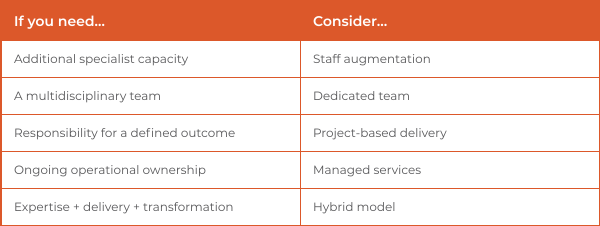
The more responsibility moves to the provider, the more important delivery governance and outcome-based KPIs become.
3. The cheapest team wins the procurement process - but not the project
Cost is a legitimate reason to outsource. It is not a sufficient basis for selecting a partner. A team with a lower hourly rate can become significantly more expensive if it requires extensive supervision, has limited domain knowledge or lacks senior architecture and delivery expertise.
The same applies to team composition. A project may look cheaper with eight developers and no dedicated architect. But if architectural decisions must be revisited six months later, the apparent saving disappears quickly.
This is particularly relevant in CEE, where the technology market is increasingly moving toward higher-value engineering and specialized capabilities. Poland's IT market grew from EUR 22.8 billion in 2021 to EUR 34.8 billion in 2025, according to NATEK's 2026 report. The report also identifies shortages of senior specialists as a structural constraint on technology adoption.
What to do instead
Evaluate the total cost of delivery, not just the cost of individual resources.
Consider:
- seniority;
- architecture capability;
- domain expertise;
- management overhead;
- onboarding time;
- quality and testing;
- turnover risk;
- scalability;
- knowledge retention.
A lower rate is useful only when the delivery model still produces the required result.
4. Nobody owns the decisions
This is more specific than saying “communication is poor.” A project can have daily stand-ups, weekly steering meetings and excellent documentation and still fail because nobody has the authority to make important decisions.
Imagine a cloud migration where:
- the provider owns implementation;
- the client's infrastructure team controls production;
- security approves architecture;
- procurement controls changes to scope;
- the business wants a faster launch.
Everyone has a role. Nobody has enough authority to resolve the conflict. The project slows down, work is re-done and responsibility becomes difficult to trace.
What to do instead
Define ownership before delivery begins. For every major area, establish:
Who decides? Who executes? Who approves? Who is accountable?
This is particularly important when moving from staff augmentation toward managed teams or managed services. The practical test is simple:
If something important goes wrong tomorrow, can everyone immediately identify who has the authority to fix it?
If not, the governance model isn't ready.
5. The project is too rigid for the problem it is trying to solve
Enterprise technology projects rarely remain identical to the plan created on day one.
- A cloud migration uncovers legacy dependencies.
- A data project exposes data-quality problems.
- An AI initiative reveals governance requirements.
- A software product changes direction after users start testing it.
Yet some outsourcing contracts are designed as if every requirement can be known in advance. That creates a dangerous choice:
Either keep the original scope and deliver something the business no longer needs or change the scope and turn every change into a commercial dispute.
What to do instead
Separate three things:
- fixed outcomes - what must be achieved;
- known scope - what is currently understood;
- assumptions - what still needs to be validated.
Then create a defined change mechanism.
This is especially important in areas such as AI. NATEK's CEE report shows how quickly enterprise technology requirements are changing: Poland already had 44% of companies deploying AI agents, while demand is increasingly moving toward specialised AI, data and automation skills.
A five-year outsourcing relationship cannot be governed effectively using assumptions that were made before the technology landscape changed.
A better way to think about outsourcing success
The five problems above have something in common. They are not primarily engineering problems. They are design problems. The client must design an operating model in which the external team can succeed.
That means answering five questions before the project starts:
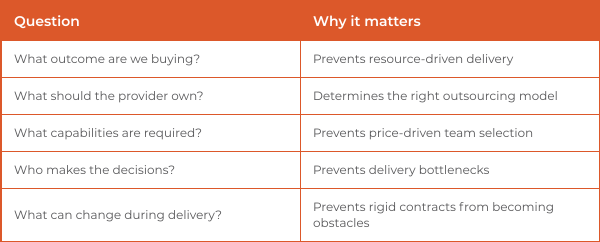
This is also where the relationship between client and provider matters.
“The best technology partnerships don't start with a list of roles to fill. They start with understanding the business challenge. Once that challenge is clear, selecting the right delivery model becomes much easier.”

The outsourcing market is moving in this direction anyway
The broader market data supports this shift. ITwiz BEST100 2026 reports that the Polish IT market reached PLN 94.7 billion in 2025, while the CEE IT Market Report 2026 puts the wider regional IT market on a growth trajectory of 9.8% average annual growth between 2021 and 2025.
At the same time, the nature of the work is changing. Poland's IT market has been moving away from traditional outsourcing toward higher-value R&D and digital transformation projects. That changes what enterprises should expect from an outsourcing partner.
The question is increasingly not:
“How many people can you provide?”
It is:
“Can you give us the expertise, delivery capability and accountability required to achieve the result?”
“Technology alone doesn't create successful transformation. People do. The role of an outsourcing partner is no longer limited to providing specialists - it is about connecting technology with business goals and taking responsibility for delivering lasting results.”
How to prevent an IT outsourcing project from failing
Before signing the contract, make sure you can answer these questions:
- Outcome: What business result are we trying to achieve?
- Model: Why is this outsourcing model appropriate?
- Capabilities: Do we have the right combination of technical and domain expertise?
- Ownership: Who is accountable for delivery?
- Decisions: Who can make critical decisions without waiting for another committee?
- Economics: Are we optimizing total delivery cost rather than hourly rates?
- Change: What happens when assumptions prove wrong?
- Measurement: Which KPIs tell us whether the project is succeeding?
If those answers are clear, the outsourcing relationship has a much stronger foundation. If they aren't, adding more developers probably won't solve the problem.
IT outsourcing doesn't fail simply because an external team makes mistakes. It often fails because the organization outsourced the work without designing how the work should be delivered. The strongest engagements start with the business problem, select the delivery model accordingly, establish clear ownership and measure outcomes rather than activity. That is the difference between buying IT capacity and building an effective technology partnership.
Before asking an outsourcing provider how many engineers it can provide, ask what outcome you need them to help deliver.
Looking for the right IT outsourcing partner?
Finding the right outsourcing partner doesn't have to be another long search. If you're looking for a trusted nearshore partner to support your software engineering, cloud transformation, cybersecurity, data or AI initiatives, contact Andrzej Osman, Sales Prospection Team Lead at NATEK. He can discuss your requirements and help you identify the right delivery model and team for your project.